Hot Oil, No Panic: Learning to Fry South Asian Snacks by Feel
Let's get something out of the way: deep-frying has a reputation problem. It sounds dangerous, messy, and technical. And if you've ever dropped a samosa into oil that wasn't ready and watched it sit there absorbing fat like a sponge, or tossed one in too-hot oil and pulled out a pale-inside, dark-outside disaster — yeah, you get it.
But here's what nobody tells you upfront: the oil is always communicating. Once you know what it's saying, frying becomes one of the most satisfying and controllable cooking methods in your kitchen.
Why Thermometers Are a Starting Point, Not the Whole Story
A kitchen thermometer is genuinely useful, and if you have one, use it. For most South Asian fried snacks — samosas, pakoras, bhajiyas, kachori — you're generally working in the 325°F to 375°F range depending on what you're frying and how thick the shell is.
But thermometers only tell you the temperature at one point in the oil at one moment. They don't tell you how the oil temperature is responding to what you're adding, how your specific pot is conducting heat, or whether your stove runs hot or cool. That's where sensory reading comes in — and it's a skill that will serve you far longer than any gadget.
The Bread Test (and Why It Actually Works)
The classic test: drop a small cube of bread into the oil. If it turns golden in about 60 seconds, you're around 350°F — a solid all-purpose frying temperature for most South Asian snacks. Faster than that and your oil is too hot. Slower, and it needs more time.
You can do the same thing with a tiny pinch of dough if you're making samosas from scratch. Drop it in. If it sinks and slowly rises, oil is on the cooler side. If it immediately floats and starts bubbling actively around the edges, you're in the right zone. If it browns in seconds, pull the heat back.
Reading the Bubbles
This is the real skill, and it's more readable than people think.
When you first lower a samosa into properly heated oil, you should hear an immediate, assertive sizzle — not a whisper, not a violent splatter, but a confident, steady sound. The oil around the samosa should bubble vigorously in a tight cluster around the surface of the food.
Those bubbles are moisture escaping from the dough as steam. As long as they're active, the food is cooking and not absorbing oil. When the bubbles start to slow down and the sound quiets, that's your cue that the moisture is mostly cooked off and you're getting close to done.
If the bubbles are violent and the oil is spattering aggressively, your temperature is too high. Turn it down and give it a minute before adding more food.
If the food sinks and barely bubbles at all, the oil is too cool. The food will sit in the oil absorbing fat instead of forming a crust. Pull it out, let the oil come up to temperature, and try again.
The Smell Tells You More Than You Think
Oil that's at the right temperature has a clean, neutral smell — hot, but not sharp. When you add food, you'll get the specific aroma of whatever's in the dough or batter, which is a good sign.
If you smell something acrid or notice the oil starting to smoke, you've crossed into too-hot territory. Most neutral oils have smoke points well above typical frying temperatures, so if you're seeing smoke, something is wrong — either the heat is too high, or there are food particles burning in the oil.
Small burnt bits in the oil are a real problem in batched frying. They lower the smoke point of the oil and give everything a slightly bitter, off flavor. Use a spider strainer or slotted spoon to fish out any stray crumbs between batches.
Samosa-Specific Tips
Samosas deserve their own section because they have a thicker shell than something like a pakora, and that changes the frying strategy.
Start lower — around 325°F — for the first few minutes. This gives the dough time to cook through before the outside gets too dark. A samosa that's perfectly golden on the outside but still raw and doughy inside is a common result of oil that's too hot.
Once the shell has set and you're seeing a light golden color, you can nudge the heat up slightly to finish and deepen the color. This two-stage approach gives you control that single-temperature frying doesn't.
Another thing: don't overcrowd the pot. Adding too many samosas at once drops the oil temperature dramatically, and you end up with that greasy, soggy result everyone dreads. Fry in small batches — two or three at a time in a standard pot — and let the oil come back to temperature between rounds.
Knowing When It's Done
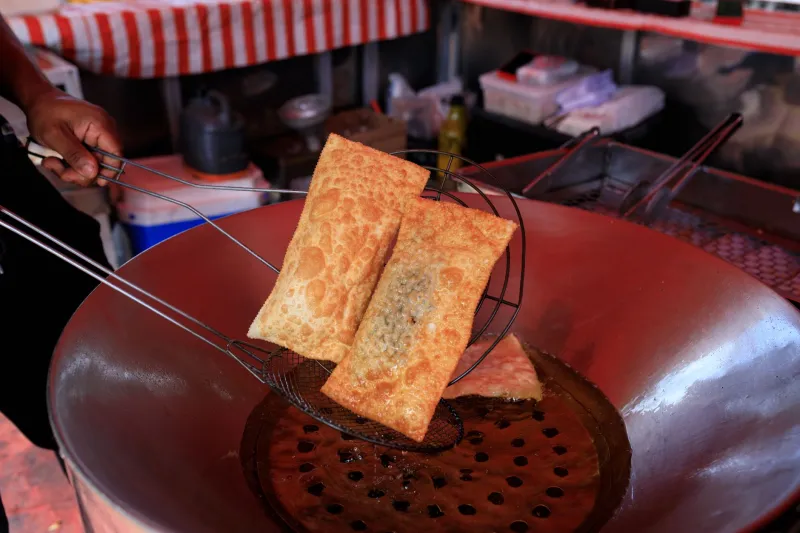
Color is your main visual cue. For samosas and kachori, you're looking for a deep, even golden-brown — not pale yellow, not mahogany. The color should be uniform across the surface, which tells you it cooked evenly.
Tap it gently with your spoon. A properly fried samosa sounds slightly hollow and feels firm, not soft. If it's still giving under pressure, it needs more time.
Lift it out and watch what happens when you set it on the draining rack. A well-fried samosa will look crisp immediately and stay that way. If it quickly looks wet or greasy, the oil was too cool during frying.
Building the Intuition
The first time you fry samosas, you're going to be watching everything closely. The second time, a little less. By the fifth or sixth time, you'll be adjusting heat instinctively based on the sound alone.
That's how this works. You're not just following a recipe — you're building a relationship with your stove, your pot, your oil, and the food itself. South Asian cooking has always been about that kind of intuitive knowledge, passed down not through written instructions but through standing next to someone and watching, listening, smelling.
You're doing the same thing, just with your own kitchen as the teacher.